



Urgent action needed to protect people from Eswatini’s asbestos contamination, say civil society groups

By Nokukhanya Musi
Eswatini must take action to protect children and its environment from asbestos mining waste, civil society groups have told Confront.
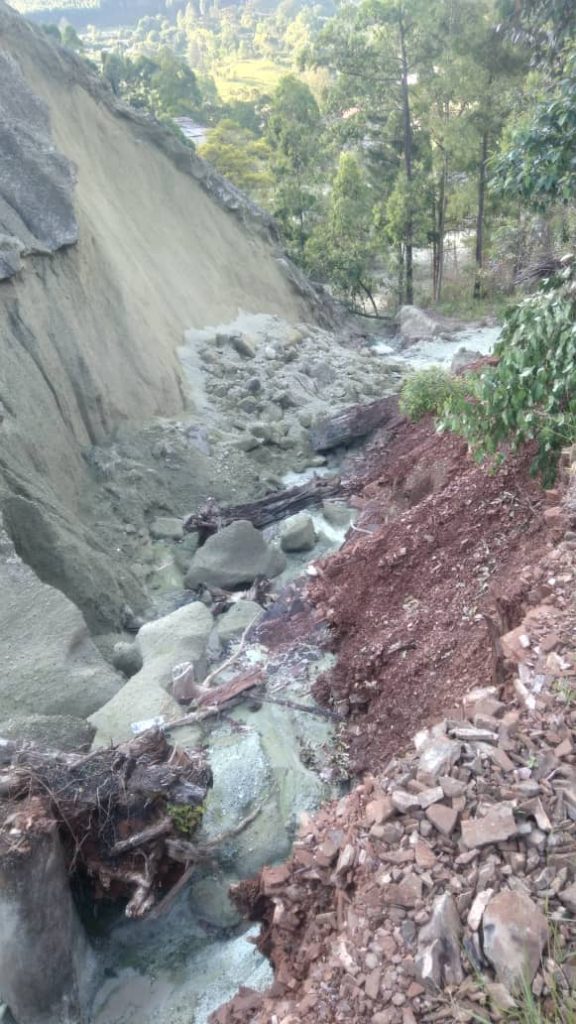
Situated in southern Africa, Eswatini’s Havelock white asbestos mine closed down over two decades ago, but it left the nearby town of Bulembu burdened with an estimated 50 million tons of asbestos waste, piled some 180 metres high. Much of the waste lies uncontained, shedding microscopic, carcinogenic fibres into the air, particularly during the windy weather. Exposure to asbestos fibres can cause several fatal illnesses, usually decades after exposure, including mesothelioma, lung cancer, and asbestosis.
In August, Confront reported that people in Bulembu with suspected asbestos diseases are left without sufficient treatment or diagnostic facilities, angry with the government for its inaction.
Now, the Swaziland Litigation Centre, Eswatini Climate Coalition, Foundation for Socio-Economic Justice, and Swaziland Rural Women’s Assembly say that those vulnerable to developing asbestos diseases in the future need protection, including efforts to mitigate the environmental pollution in the area.
“The clean-up process must be a priority,” said Executive Director of the Swaziland Litigation Centre, Mzwandile Masuku. “The residents of Bulembu deserve a safe environment.”
An orphanage amidst the waste
The asbestos mine had only been closed for five years when an orphanage was opened in 2006. Operated by non-profit Bulembu Ministries, and initially owned by the country’s current Finance Minister Neal Rijkenberg, the orphanage is home to over 300 children. When asked why he had chosen Bulembu as the site for the orphanage, Rijkenberg said: “I am a Christian. I felt that God had brought me here”, reported The Mail & Guardian.
Bulembu Ministries previously said that it conducts regular air and water quality testing. “We believe the environment remains safe,” a spokesperson said.
According to the World Health Organisation, there is no safe level of exposure to asbestos, leaving civil society groups concerned for Bulembu residents. Eswatini Climate Coalition founder Dane Armstrong told Confront, “We cannot ignore the fact that these children are living in an environment that could compromise their health, raising profound ethical questions about the safety of vulnerable populations.”


The Swaziland Litigation Centre echoed these sentiments. “We need a collective effort to tackle this issue. It’s not just about cleanup; it’s about justice and ensuring that the past does not dictate the future for these children,” said Mzwandile. Justice would involve health monitoring of those deemed at risk, and support for those affected by asbestos exposure, he added.
“The health implications for children at Bulembu Ministries and the wider community are dire,” Thabo Masuku, the Executive Director for the Foundation for Socio-Economic Justice, told Confront. “Immediate action is necessary to address the health and environmental crises stemming from asbestos contamination.”
Last year, a rehabilitation project that would have included extracting rare minerals from the waste was cancelled after the contracted company, Kobolondo Magnesium, had its mining license revoked.
Thabo argues that the local community needs to be involved in initiatives going forward. This includes better management of the asbestos waste and monitoring of those at risk of developing diseases. “We need to ensure that the cleanup is not just a promise, but a reality,” he said.
Failure by the state
Lonhlanhla Mthethwa, Chairperson of the Swaziland Rural Women’s Assembly (SRWA) and SRWA member Thabile Dlamini have both lived in the Bulembu area. Ill health among residents in the community is just one consequence of the asbestos mining; environmental damage still plagues the area.
“Many cattle, which are a source of livelihood for our people, have fallen into these mine openings,” said Dlamini “The unhealthy soil has led to poor crop yields each planting season.”

“The contamination is not just an environmental issue; it affects our very lives,” Mthethwa told Confront. “The unclean water from local rivers flows into larger rivers that supply many parts of the country, putting countless lives at risk.”
Eswatini’s Senior Mining Engineer at the Minerals and Mines Department, Richard Bong’sipho Magagula, told Confront that rainfall and surface runoff wash asbestos fibres into nearby streams and rivers. Over time, these fibres accumulate, reducing the water quality and endangering wildlife.
This contaminated water heads downstream to large waterways, spreading the asbestos fibres, particularly during droughts. Meanwhile, grazing livestock ingest asbestos-tainted plants. This risks transferring fibres into the food chain, said Magagula. “This raises long-term risks for both ecosystem health and human food safety,” said Magagula.
Continued inaction risks even more harm. A 2022 environmental impact report that was conducted as part of a cancelled rehabilitation project identified that a changing climate could cause a “catastrophic collapse of the tailings” if the waste is left unabated. Bulembu Ministries declined to directly comment on whether or not the tailings were at risk of collapsing, instead referring Confront to the Eswatini Government.
Launching a comprehensive rehabilitation project to manage the asbestos waste is not cheap. Magagula told Confront that, in theory, the ‘polluter pays’ principle applies. “However, in this case, the mine has been closed and is now without an owner, rendering responsibility for the site with the government of Eswatini. Given the scale and severity of the environmental impact, securing adequate funding for remediation presents a significant challenge,” he added.
We approached the government department responsible, led by the Commissioner of Mines for the Ministry of Natural Resources and Energy, Dr Noah Nhleko, with several questions.
These included his assessment of the current environmental situation in Bulembu, any plans to mitigate the risk to residents, and the government’s long-term strategy for managing the legacy of asbestos mining in Eswatini.
The Commissioner declined to answer any questions. At one point, he asked to see the personal medical records of the sick people we interviewed before responding. Later, he falsely suggested that Confront was somehow tied to Kobolondo Magnesium, the Mauritian mining company whose rehabilitation project was cancelled, as a reason for not responding. “I can not be seen to be aiding an applicant,” he wrote.
There are currently no active plans to fully rehabilitate the waste in Bulembu, nor to provide additional support for those at risk of contracting or already living with asbestos-related diseases.
Residents are fully aware they are paying the price for decisions made by executives decades ago. “The companies that profited from the land have moved on, but the people of Bulembu are still there, living with the fallout,” said Thabo.
A failure to sufficiently tackle the asbestos problem in Eswatini has dragged on for years. “The state seems to think that they can wish this problem away,” said Mthethwa. “But we know the reality on the ground”.
This story was first published by Confront


