



SOMHLOLO SCANDAL: Unaccredited suppliers cripple eSwatini’s Olympic dreams

By INHLASE REPORTER
While the kingdom’s football fans have grown weary of the perennial stadium crisis that has forced the national team, Sihlangu Semnikati, to play home games in South Africa, a more quiet and devastating tragedy is unfolding beneath the feet of eSwatini’s athletes.
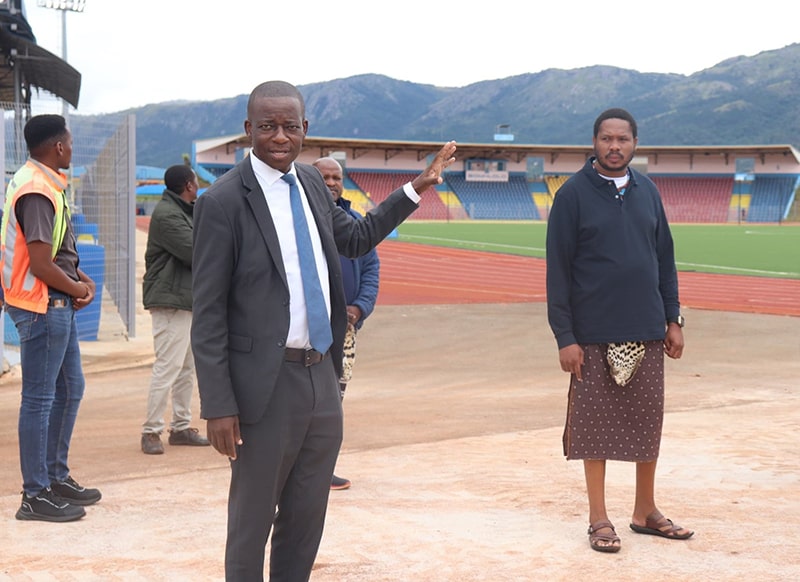
An investigation by Inhlase can reveal systemic failures in project management, oversight, and procurement integrity at the Ministry of Sports, Culture and Youth Affairs and the Microprojects Unit. At the heart of the scandal is the E6.4 million synthetic athletic track at Somhlolo National Stadium—a facility that was meant to usher in a new era for local sprinters but has instead become a symbol of wasted taxpayer funds and shattered sporting ambitions.
Since its installation in 2021, the track has not only failed to meet international standards. Still, it has physically disintegrated, leaving the nation’s elite athletes to train on dangerous roadsides or pay exorbitant fees for the only other viable facility in the country.
The disqualification of Somhlolo National Stadium by FIFA and the Confederation of African Football (CAF) is well-documented. For three years, eSwatini’s football has been deemed unfit for international football. This failure has come at a staggering price.
Whenever Sihlangu Semnikati plays a “home” game, the government is forced to rent Mbombela Stadium in Mpumalanga, South Africa. According to submissions made to Parliament by the Minister of Sports, each “home” game played abroad costs the taxpayer at least E1 million. Between 2023 and 2024 alone, the country haemorrhaged approximately E18 million to host games across the border.
However, while the football crisis grabs the headlines, the athletic fraternity has been suffering in the shadows. For athletes, the stadium is not just a venue for a 90-minute match; it is a training laboratory. Without it, the pipeline of talent for regional and international competitions is being systematically choked.
The Phantom Accreditation: A E6.4m Gamble
The core of the investigation lies in procuring the synthetic track. In 2021, a contract for the supply and installation of the track was awarded to Synthetic Grass and Track Africa. The company was a subcontractor engaged by Construction Associates. The tender was valued at E5 588 000 (excluding VAT), totalling E6 426 200 once taxes were factored in.
According to a damning audit report conducted by the Office of the Auditor General (AG), the supplier was appointed based on “purported accreditation” aligned with World Athletics (formerly IAAF) standards.
However, when the Auditor General sought to verify these claims, the house of cards collapsed.
“Upon further verification, no evidence of such accreditation could be confirmed,” the AG report states.
The implications of this are dire. Without World Athletics accreditation, there is no guarantee that the materials used meet international safety or performance metrics. This lack of certification effectively renders any time clocked on the track unofficial for international qualification and, more critically, explains the track’s premature physical failure.
Inhlase has established that despite repeated requests from the Auditor General and internal stakeholders for the Ministry of Sports to provide a valid accreditation certificate, no such document has been produced to date.
Built to Fail: Construction Chaos
The physical state of the track is a testament to what expert’s call “catastrophic project management.” A physical inspection conducted on 12 May 2025 confirmed that the track, completed only in late 2021, is already riddled with holes, peeling surfaces, and visible tears. This is still the case even today, as it has not been fully repaired.
The timeline of destruction, as reconstructed by Inhlase, suggests a total lack of coordination between the Microprojects Unit (under the Ministry of Economic Planning and Development) and the Ministry of Sports.
According to Microprojects Chief Executive Officer, Sibusiso Mbingo, the track was certified complete in February 2022. However, the subsequent “maintenance” of the site reads like a comedy of errors:
Heavy Traffic: Sections of the delicate synthetic surface were damaged by buses carrying players during local league games.
Environmental Neglect: Roofing sheets from nearby ablution blocks, poorly secured, were blown off during windstorms, slicing into the turf.
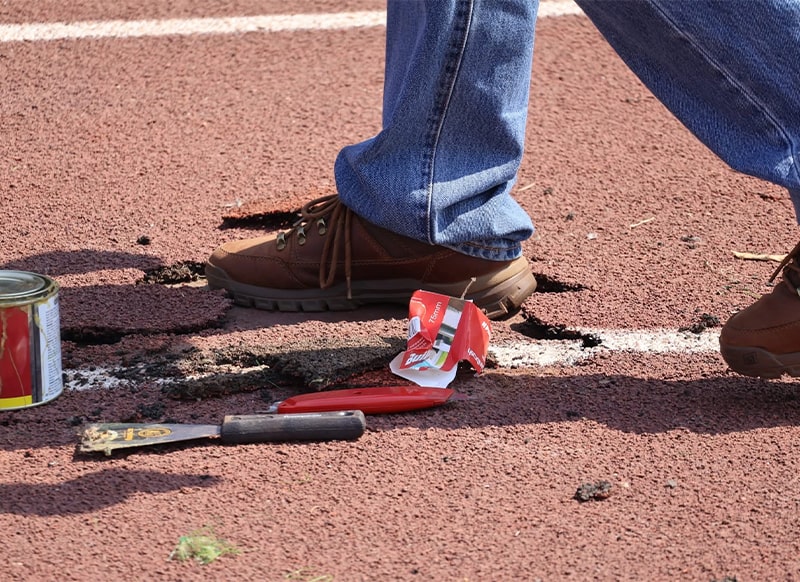
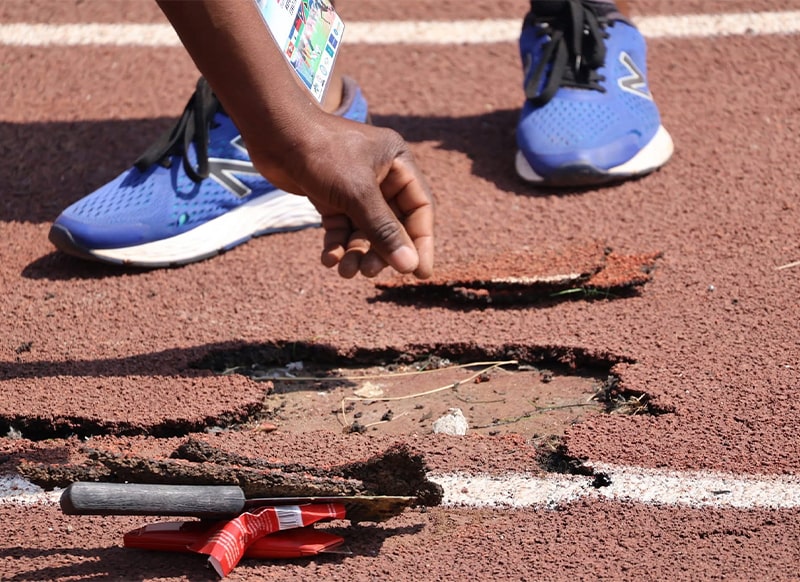

Construction Blunders: In May 2023, during the extension of the main grandstand, heavy construction equipment was driven directly over the track.
Sandziso Vilakati, a Project Management Specialist, says the sequence of events defies all industry logic.
“In any major construction project, the flooring—especially specialised surfaces like an athletic track—is the final step,” Vilakati explained. “I don’t understand why a track would be installed while heavy structural work was still ongoing. If you must do it, you protect it. You do not allow heavy vehicles to move on a surface that is not designed to carry heavy loads. It is basic oversight that failed here.”
The Blame Game
When confronted with the damage, the Ministry of Sports and the Microprojects Unit have engaged in a bureaucratic dance of finger-pointing.
Mlayeto Dlamini, Principal Secretary at the Ministry of Sports, shifted responsibility to Microprojects, noting that they were the implementing entity. Meanwhile, the main contractor, Construction Associates (a subsidiary of Inyatsi Group), has remained tight-lipped. When approached by Inhlase to explain the criteria for appointing the unaccredited subcontractor, Ncobile Dlamini of Inyatsi Group did not provide a detailed response.
Microprojects CEO Mbingo defended the process, claiming the subcontractor did have certification from World Athletics and the American Sports Builders Association (ASBA), despite the Auditor General’s findings to the contrary. Mbingo further argued that under the JBCC 2018 contract terms used for the project, the contractor is technically liable for damages during construction.
Yet, as the legalities are debated in air-conditioned offices, the track remains a ruin.
The Human Cost: Training on the Road
For the athletes, the “Somhlolo Scandal” is not about tenders or Value Added Tax (VAT); it is about survival.
Victor “Mavikane” Dlamini, Public Relations Officer for Athletics Eswatini (AE), paints a bleak picture of the sport’s current state. “The closure of Somhlolo hit us hard,” he said. “The country only has Somhlolo and Mavuso. Because Somhlolo is unusable, everyone has flocked to Mavuso, and now that track is also starting to fail due to overuse.”
Dlamini revealed a shocking lack of consultation. The federation, which represents the facility’s end-users, was never asked for input on the contractor or the track’s technical specifications. “If they had consulted us, we would have pointed them toward credible, verified suppliers because we know who produces tracks that last,” he added.
In the absence of a safe, free national stadium, eSwatini’s runners have been forced onto the country’s public roads.
“Our athletes are training on the roadsides. Most roads in eSwatini don’t have markings or lanes for runners. They are being exposed to traffic accidents every single day to stay in shape,” Dlamini lamented.
The psychological toll is equally heavy. An athlete training on a crumbling, unaccredited track cannot accurately measure their progress against international benchmarks. When they eventually reach international meets, they are at a distinct disadvantage, having spent years adjusting their stride to avoid holes and peeling rubber.
The Somhlolo National Stadium refurbishment was intended as a “Revamp Project” to restore national pride. Instead, the persistent failure of the Ministry of Sports to exercise oversight and the Microprojects Unit’s inability to verify supplier credentials have resulted in:
E18 million spent on South African stadium rentals.
E6.4 million spent on a “disposable” athletic track.
E45 million in cumulative allocations over three years with no FIFA-approved stadium to show for it.
The Auditor General has called for immediate recourse, demanding that the Controlling Officer provide a product warranty and ensure the service provider fixes the damage at their own cost. However, with no verified accreditation on file, the legal standing for a warranty claim remains murky.
While the government continues to put money into Somhlolo, that money is effectively being poured into a sieve. Until there is accountability for the appointment of unaccredited suppliers and the “poor project management” that allowed heavy machinery to crush a multi-million Emalangeni track, eSwatini’s athletes will remain runners without a path—stuck on the roadside while the rest of the world races ahead.


