

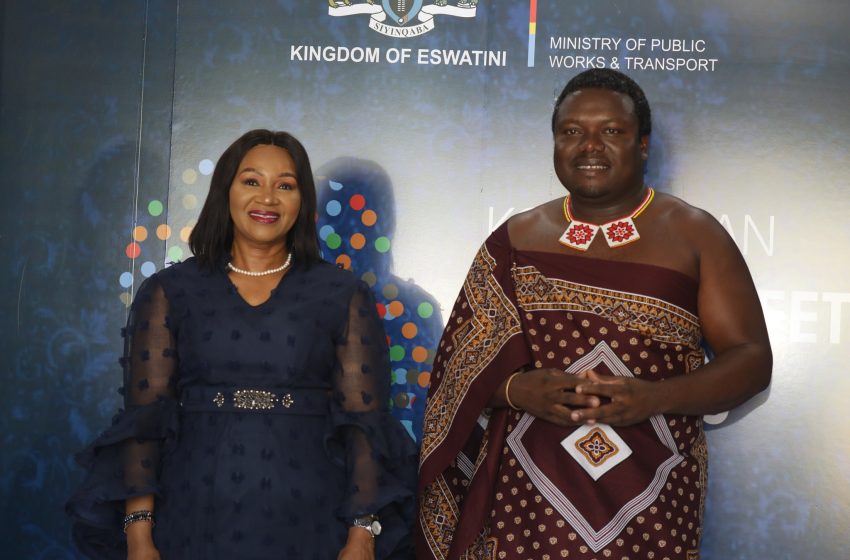
Former Minister of Public Works Ps Lindiwe Dlamini & Minister of Public Works Chief Ndlaluhlaza Ndwandwe
Eswatini’s Double Debt: Nhlangano – Sicunusa Road scandal deepens

BY INHLASE REPORTER
As of October 2025, the Government of Eswatini has entered a new and troubling financial reality regarding the Nhlangano-Sicunusa Public Road (MR13). With the Defects Liability Period now expired, the state is fully responsible for maintaining the road and repairing any defects at its own cost. At the same time, the state continues to service two massive loans for the same stretch of road while no one has been arrested or charged for the documented loss of over E576 million incurred during the project’s first failed phase.
Seven years after the Auditor General (AG) exposed the staggering procurement violations and financial irregularities in the initial construction of MR13, accountability remains absent. Parliament, the Ministries of Finance, Public Works and Transport, the Anti-Corruption Commission (ACC) and the Royal Eswatini Police Service (REPS) have all failed to translate clear audit findings into criminal prosecutions. Inhlase has uncovered a scandal in which taxpayers are paying twice for one road—one for a project that collapsed, and again for its rescue—while justice has been indefinitely deferred.
According to the Treasury report for the financial year ended March 2024 tabled this year in Parliament, the government paid a total of E634 128 514.65 to Inyatsi Construction in 2024 alone for the completion of MR13. At the same time, for the financial year ended March 31, 2024, the government paid E123 001 942.45 towards the initial funders, Arab Bank for Economic Development in Africa (BADEA), and the OPEC Fund for International Development (OFID) for the first, failed phase of the project. This means taxpayers are simultaneously repaying loans for a project that collapsed amid massive irregularities, and for a second loan to complete the same road.
It is, in effect, double debt for a single road, with no recovery of the stolen funds.
2007–2013: The Genesis of the Heist
The history of the MR13 road began with optimism. On December 4, 2007, a project loan was approved to upgrade the gravel road connecting the agricultural hubs of the Shiselweni region to the Gege border post. The strategic intent was sound: boost tourism, facilitate trade, and improve access to social amenities.
The financing was secured through the Arab Bank for Economic Development in Africa (BADEA) and the OPEC Fund for International Development (OFID). The loan agreement, signed in June 2009, totalled approximately US$12.5 million from OFID alone, with co-financing from the government.
However, the rot set in before the first shovel hit the ground.
According to the AG’s report for the financial year ended March 31, 2018, which was tabled in Parliament in 2019, the Ministry of Public Works and Transport flagged the project for disaster during the pre-qualification stage in 2013. The contract was awarded to a Joint Venture (JV) between Kukhanya Civil Engineering and Gabriel Couto.
The AG’s investigation revealed that this JV had failed to meet pre-qualification requirements twice. Despite being highlighted in a Prequalification Evaluation Report (PER) as a disqualified entity, they were inexplicably recommended to proceed to the tendering stage. Furthermore, the contractor was appointed without the funding agencies’ approval—a direct violation of the loan agreement, which stipulated that the funders must pre-approve the contractor.
This initial act of non-compliance by the Ministry of Public Works laid the foundation for the chaos that followed. Gabriel Couto, the partner with the technical capacity, withdrew from the joint venture shortly after the funders indicated they would not finance the project due to these irregularities. This left Kukhanya Civil Engineering, a firm the AG noted lacked the requisite capacity, to handle a significant infrastructure project alone.
2013–2019: The E576 Million Sinkhole
Between 2013 and 2019, the project became a conduit for the transfer of unexplained wealth. The initial project cost was fixed at E298.22 million in 2013, with an expected duration of 24 months. By 2016, the price had escalated to E465 million. By the time the project was halted, payments exceeded E576 101 574.86.
The AG’s audit unearthed a litany of fiscal irregularities that the Ministry of Finance approved despite obvious red flags:
- Phantom Consultancy Fees: An amount of E16 444 660 was paid by the government to MZCK Consultants. This was despite the loan agreement clearly stating that the funders (BADEA/OFID) were responsible for the consultancy fees. Furthermore, the costs were arbitrarily inflated by E5 million above the agreed E10 million cap without explanation.
- The Land Compensation Scandal: A farm owner, whose land was affected by the road alignment, was legally due for compensation of E191 132.88. Instead, the government paid out E3 000 000, an unjustified overpayment of nearly 1 500%.
- Interest on Incompetence: The taxpayer footed a bill of E14 457 718.15 purely for interest on late payments, a direct result of administrative lethargy within the Treasury and Ministry of Finance.
By June 2019, the situation on the ground was apocalyptic. A site visit by the Public Accounts Committee (PAC) revealed that the ministry’s claim of 75% completion was a fabrication. The road was riddled with deep gullies, trees were sprouting in the centre of the thoroughfare, and construction material lay rotting. Residents suffered cracked walls from vibrations and dust, while trenches cut off access to local shops.
Parliament: The Watchdog That Didn’t Bite
The role of Parliament, specifically the PAC, in this saga highlights a crisis of enforcement. Following the shocking 2019 site visit, the Committee issued strong recommendations:
- Immediate termination of the contract to stop the E5 million monthly penalties.
- A calculation of costs to complete the project.
- A forensic audit is to be instituted within six months.
The PAC went so far as to threaten the Controlling Officers of the Prime Minister’s Office, the Ministry of Public Works, and the Ministry of Finance with contempt of Parliament if they failed to act.
However, these threats proved empty. While the contract was eventually terminated in June 2020, the accountability mechanism stalled. The promised forensic audit, intended to gather criminal evidence, fell victim to intimidation, exposing the state security apparatus’s inability to protect the pursuit of justice.

The Fugitive Auditor and Police Inaction
Perhaps the most damning indictment of the Eswatini justice system is the fate of the forensic investigation. Initiated in 2021, the audit was contracted to an independent firm from South Africa after the Minister of Finance, Neal Rijkenberg, announced publicly the engagement of Inyatsi Construction to complete the public road.
The Auditor General, Timothy Matsebula, later revealed a chilling sequence of events to the PAC in a closed session last year when he was quizzed about the forensic report. It was revealed to the committee that, as the forensic auditor prepared to move to the crucial phase of the investigation, assembling criminal evidence for prosecution, he began receiving death threats. The threats escalated to such a degree of danger that the auditor was forced to flee the country.
Further, information reveals that the investigator was so terrified that he “left the report of the uncompleted project at the border gate” because he was too scared to set foot in Eswatini. Despite all the information shared, there has not been a single case opened with the police by either the office of the AG or PAC. Noteworthy the PAC’s partners are apart from the of Members of Parliament and the AG’s office include the Ministry of Finance, the Anti-Corruption Commission (ACC), and the Royal Eswatini Police Service (REPS). The Chief Police Information and Communications Officer, Senior Superintendent Phindile Vilakati, also confirmed that no case had been recorded or any arrest made in relation to this case.
The PPP Era: Completed Works, Endless Payments
With the first E576 million gone and the road still a dirt track, the government’s solution was not to recover the stolen funds, but to borrow more.
In late 2021, the government engaged Inyatsi Construction in a Design, Finance, and Build Public-Private Partnership (PPP). This arrangement was codified in an Act of Parliament assented to by the King on November 4, 2021. The government effectively borrowed E647 378 644 from the contractor’s financing structure to pay the contractor. The repayment terms, according to leaked documents ‘Swazi Secrets’, involve 27 instalments over 15 years at an interest rate of prime plus 1.25%.
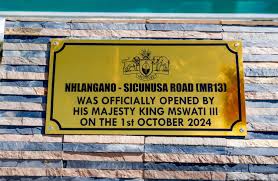
To complete the aborted works, Inyatsi Construction commenced operations on January 7, 2022, and completed the works on March 31, 2024. The road is now fully open to traffic, a stark contrast to the gullies of 2019. King Mswati III officially opened the road on October 1, 2025. The contractor, Inyatsi Construction, had a defect period of 1 year, which lapsed on September 31, 2025.
October 2025: The Liability Trap and Supplementary Budgets
However, while the physical construction is finished, the financial bleeding has entered a new phase.
According to a report presented by the Minister of Public Works and Transport, Chief Ndlaluhlaza Ndwandwe, last month, the Defects Liability Period (DLP) expired at the end of September 2025.
This is a critical turning point. As of October 2025, the contractor was no longer responsible for rectifying defects at their own cost. The government is now solely liable for the road’s condition. This creates a scenario where the taxpayer is paying:
- The repayment on the original BADEA/OFID loans (for the failed initial project).
- The repayment on the Inyatsi PPP loan (for the completion).
- The full cost of maintenance and defect repair starting from October 2025.
Furthermore, the completion of the road has not ended the immediate cash demands. The Ministry has admitted that, despite the road being open, there are still outstanding contractual obligations, including a request through a supplementary budget to put some to rest.
“The project continues to have outstanding commitments from the previous contract between the Eswatini Government and the joint venture of Gabriel Couto/Kukhanya Civil Engineering. The process for concluding this contract is now at the adjudication stage. The Dispute and Arbitration Board (DAB) reviewed all claims from both the Contractor and Employer. All claims submitted by both parties were rejected. The contractor filed a notice of dissatisfaction, and the matter is now being considered under clause 20.5 of the FIDIC rules to explore possibilities of an amicable settlement before escalation to arbitration. The Ministry is seeking advice from the office of the Attorney General to put this matter to final rest,” said the minister.
But “putting the matter to rest” legally is not the same as serving justice.
Principal Secretary in the Ministry of Public Works and Transport, Thulani Mkhlaliphi, said they were also waiting for the forensic audit report from the office of the AG to act on some of the issues about the funds that were mismanaged during the first attempt at the road. He mentioned that they request quarterly updates to the office, given that the first audit lacked the criminality aspect.
“As you may know, the AG’s office is the one handling issues of the forensic report, which will enable us to charge people and all other parties. Further, some matters of the issues are still pending in court; therefore, commenting on them further might be sub-judice,” he said.
The AG revealed that they encountered challenges in conducting a forensic investigation into the over E576 million used for the construction of the Nhlangano-Sicunusa (MR13) road due to limited resources and restrictions.
In July this year, when the PAC requested an update from the AG and the Ministry of Public Works and Transport, the AG admitted to the PAC that his office remains incapacitated due to restrictions and limited resources that prevent independent engagement of investigators. He acknowledged that the initial forensic auditor failed to perform the final term of reference: gathering evidence for criminal charges. Because this phase was not completed, the evidence remains uncollected, and the prosecutions are unborn.
“We were delayed because we did not have the resources, but we will conduct the investigation,” he said.
Matsebula said they now had someone responsible for the legal aspects of the forensic audits, adding that he was hopeful they would make progress.
“This is a specialised field; it requires one to source the right people outside. We are joining hands with other institutions to help us. We have already made bids so that we can do the work,” he added.
Notably, the government had budgeted E8 million for the forensic audit. The AG explained that the first investigator was not paid the whole amount under the contract; therefore, funds remain available for the remainder of the audit.
In an interview, Communication and Stakeholder Engagement Officer at the AG’s office, Bongile Mavuso, said they were working on the necessary process to find and engage a new consultant. She shared that the tender has not been issued yet, but the office was finalising all the preparatory work.
“A meeting was held on this issue, and an advert would be made public,” she said.
The Nhlangano-Sicunusa road is now drivable. But beneath the asphalt lies a crime scene that has been paved over. The Ministry of Finance continues to sign off on loan repayments for money that yielded no results. The Ministry of Public Works has not sanctioned the officials who allowed a disqualified contractor to proceed in 2013. Parliament has failed to enforce its contempt charges against controlling officers.
The E576 million remains unaccounted for, a ghost debt on the ledger of the nation, while the perpetrators likely drive comfortably on the very road they failed to build.


